The Further Adventures of a Wildlife Enthusiast, Amateur Fly Fisherman, and Bird Lover.

Thursday, January 26, 2012

Catfish on a Fly?

This past summer 2011, I began fly fishing.  I have always loved spinner or spin-reel fishing and had thought about fly fishing as "old man's fishing".  I always knew Trout were finicky fish with particular eating habits and I would always say to my fishing buddies "bah, the Trout fuss too much." I must mention that I had never caught a Trout in my life, so the point was just blind prejudice.  One of my good friends finally convinced me a few weeks before Opening Day 2011to join him at the Musconetcong River for my introduction into fly fishing.  He warned me to not expect a catch on my first time out but, me being who I am, I would and did try my damnedest to get a fish on a fly on my first outing.  I didn't get a fish.  My first fish on a fly would not come until a week or two later and that still was not a Trout.  The first one turned out to be a Blue Gill. I was very surprised by this because I had always been under the impression that Fly fishing was for Trout only and that other fish liked other fishing styles.  Little did I know, fish don't care.  Blue Gills and other Sunnies, Crappies, Small Mouth and small Largemouth Bass were also attracted to the flies.  Over the next few weeks I learned alot about streams, bugs, fish, and how to read the water; I also bought my first fly rod and reel.  In everything I was told about fly fishing, Catfish were never mentioned.  Soon after I got my rod, some flies, and some knot tying savvy, I headed out to the very same spot where I'd had my first taste of fly fishing.  I put on a bead-head 10 size Woolybugger, black and blueish sparkly tinsel.  I proceeded to catch a Largemouth Bass and a few Sunnies.  No Trout were hitting, even though I could see them darting all around the area.  As I'm about to call it quits, I get the idea in my head to cast the fly up-stream from the submerged boulder I was fishing around.  Hopefully, this would drift the Bugger into a sinking flume on the far side of the rock and drag it low and underneath.  It worked; the fly got sucked right under.  As I'm hauling the Woolybugger out from under the rock, I felt a tap.  I kept going and saw the bait come from under rock.  No sooner than I put eyes on the bait, there came a brown/yellow flash.  I choked up on the pole and set the hook.  This fish ran hard for a few minutes until I was able to get him close and in the net.  It was a brown Catfish!  I went back to my friends with the story and some pics and they could not believe it!  I don't know if it is because you don't fly fish for Catfish or because its such and oddity but, I'm proud to say I'm the only guy I know who has caught a Catfish on a fly rig and its still early in my fly fishing adventures!!!


Wednesday, January 25, 2012

Cabin Fever!

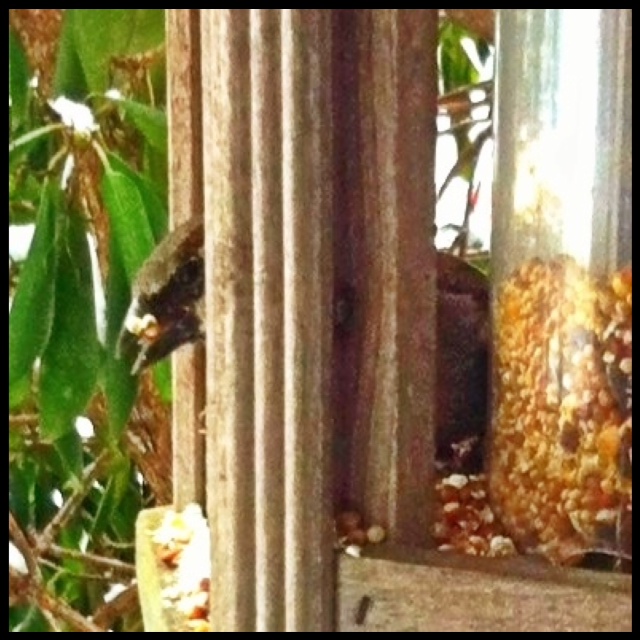
So, Winter has its icy grip on land and lake alike. I long to be outdoors. Hearing the stream running beneath me, the birds and their chatter. There is one saving grace in this dreary time and that is my bird feeder. To date I've been visited by 3 different species of Sparrow, Dark eyed Juncos, and Tufted Titmouses.  Also, the Squirrels but, they're always around.  The Cardinals showed up just recently but are not yet accustomed to my presence at the window. This is the slow time of year for wildlife and fishing in the Northeast. Can't chase Frogs or Salamanders. The birding is fairly poor except for my feeder and the few Raptors that stick it out in the cold.  The Squirrels do provide some laughs with their antics.  Chasing each other off, taking turns jumping at the feeder and failing. This is also a good time for preparation. I'm scheduling my "expeditions" and fishing trips for 2012 as well as making sure I have the knowledge of gear, tactics, and wildlife to make the coming season a success! Stay Tuned!

Dark eyed Junco (Junco hyemalis) 

House Sparrow (Passer domesticus)

Song Sparrow (Melospiza melodia)

White-Throated Sparrow (Zonotrichia alpicollis)

Gray Squirrel (Sciurus carolinensis)

Saturday, November 26, 2011

Turn to snow: an Image poem

Lush green density
In its Autumn
Wans to yellow
You can taste the smell of leaves,
Decay.
Giving over their nutrients
For next years' progeny.

The wind is now
Crisp and viscous.
That once lazy breeze
Picked up its pace
Between the Willows' limbs
Packed up its place
Amongst the Lily pads
And shuffled off.

Its only good bye:
The missing heat, the biting void of temperature.

One timely denizen dares to dwell there.
A tiny, microscopically spiny transient
Whose clarity depends on prism's refracting light,
Clearly invisible or some sense that's not sight
Were it not for it's great numbers
Were it not for it's mass disbursement.

Wednesday, November 16, 2011

Thoughts on "My Life as a Turkey" by Joe Hutto, aired by PBS.

"My Life as a Turkey" on PBS is PHENOMENAL!!! It asks the basic human question "Who's really the Turkey here?" All jokes aside, big UPS to PBS, the Author, Naturalist, and Turkey Mom Joe Hutto, and the Turkeys!!!! Joe's experience raising the wild Turkeys from chicks seemed to have a deep and very human impact on the way he perceives Nature and the Human world. An amazing look at Nature from the inside. The Turkeys gave Joe an access to and understanding of the natural world that I can only describe as "Mowgliesque". Yes, I just made that word up. I hope you can understand what I mean. If you don't, watch "My Life as a Turkey" on PBS and you will! -Bird Nerd, OUT!

Friday, October 28, 2011

One Thing

The Red Eft (Notopthalmus veridiscens Rafinesque) is the land loving juvenile version of the Northern Spotted Newts (Notopthalmus veridiscens).  I'd known both of these creatures separately for years.  Well aware that the Eft resides in the damp mulch, near moss and rocks.  It's trees are our Toadstools as it lurks amongst wood chips and beetles, fallen leaves, and the newly budding spring ferns.  Bright red with hue encircled spots, a soft almost velvet skin you'd think belongs on a baby mouse.  The Newts I would find in slow flowing, flat, and riffled streams and along the shores of blue lakes.  Hiding between the summer weeds and the flotsam of reeds that once stood up stream.  Their skins slimy filmed, tails flattened, upturned and hydrodynamic.  The only vestiges of Eft are the red spots that line along their spines.  They are the same creature in two separate stages of life. Knowing this gave me insight into their life's journey.  From water to land then back from whence they came.  I'm curious to know how the transformation takes place.  Unfortunately, as we are getting into November, my search for that knowledge will have to wait until Spring. 

Black and White Warbler (B&W Creeper)

May 16, 1860

"The whole North American forest is being thus explored for insect food now by several hundred (?) species of birds.  Each is visited by many kinds, and thus the equilibrium of the insect and vegetable kingdom is preserved."

-Henry David Thoreau, Thoreau On Birds.